
Dr. Szerlip has joined forces with Austin Orthopedic Institute
Located at: 11675 Jollyville Road Suite 207, Austin, TX 78759
and 1410 Blue Ridge Dr. Ste 100, Georgetown, TX 78626
Call 512-856-1000 to request an appointment.
Following a tibial plateau fracture, you will need to follow a structured rehabilitation program to return to full fitness and participate in sports again.
At Benjamin W. Szerlip, DO, in Austin and Georgetown, Texas, we specialize in knee and sports medicine. Schedule a consultation with our fellowship-trained shoulder and sports medicine surgeon today!
“Great staff at reception area. Very pleasant and professional medical staff. Wait time was appropriate. I appreciate Dr. Szerlip’s approach. He answered all my concerns. I’ll continue to receive steroid injections as long as they’re helpful. Then will work to create a plan to maintain my shoulder function. So, no complaints.” — Gretchen H.
Tibial plateau fractures typically occur after a high-energy injury, such as falling from a height or a car accident. It refers to an injury of the top part of your shin bone (tibia), which is also the bottom part of the knee. During high-energy trauma, the femur (thigh bone) slams down on the tibia, causing it to fracture.
A layer of cartilage covers the tibial plateau to help your knee bend and extend. This layer of cartilage can also be damaged when the tibial plateau fractures.
Tibial plateau fractures are complex injuries that usually require surgery to fix. The procedure is called open reduction internal fixation (ORIF). This means the surgeon will perform open surgery to realign the broken bones. The bones are then held together with plates, pins, or screws to maintain good alignment while healing.
Following ORIF surgery to fix the tibial plateau, you will need to undergo 6 months or more of rehabilitation. The phases of tibial plateau rehab are as follows:
For the first six weeks, your goal is to protect the surgical site to avoid complications such as infection. You’ll also take measures to minimize pain and swelling. Cryotherapy is often used to control inflammation and swelling. You may also be requested to keep your affected leg elevated.
This phase is non-weight-bearing, and you will need crutches to walk about. Your knee will be locked in a knee brace in full extension to prevent movement at the knee.
Physical therapy will focus on keeping your hips and ankle mobile and activating your quad muscles in a sitting or lying position to minimize muscle wasting. You may also be encouraged to do heel slides to bring your legs up to 90 degrees of flexion, according to your ability. Heel pumps are encouraged to maintain circulation and prevent deep vein thrombosis.
The primary goal of this phase is to restore your range of motion through the knee joint and improve your quad strength. You should also be working back to weight-bearing through this phase of rehab. At this stage, you should still not go beyond 90 degrees of flexion at your knee.
Exercises during this phase include active-assisted range of motion exercises, where your physical therapist will assist you in bending your knee. You will continue training your hip and core muscles. You can use a stationary bicycle as your range of motion returns, but you should not be running at this stage of your recovery.
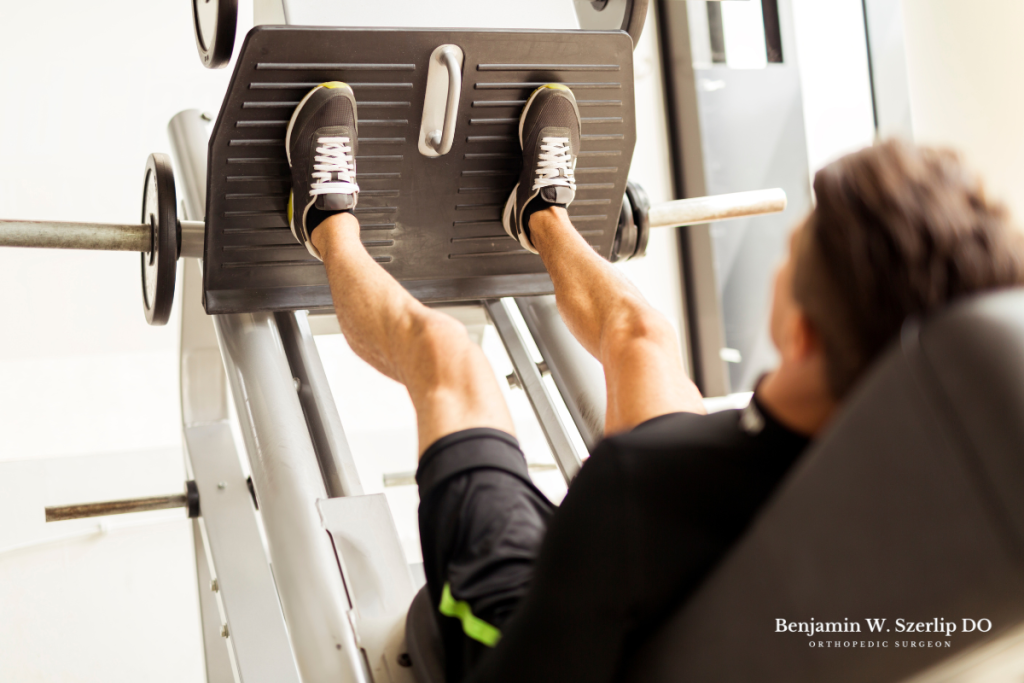
During this phase, you should be back to the full range of motion through your knee joint. Exercises will be given to restore strength in your legs, such as mini squats and leg press. You will also continue to restore your balance as you return to normal walking patterns.
You will still need to avoid exercises that cause impact on your knee. This rules out running at this time, but you can progress to using an elliptical trainer.
Your goal through this phase is to return to normal activity. Exercise will be given for functional strength and balance. These may include balancing on a single leg and lunges.
Your focus should be on low-impact fitness training. However, you can start to incorporate agility training and light plyometrics.
This is the final stage of rehab where you can prepare to integrate fully into sports. Fitness routines will now include advanced plyometrics, running, and sport drills that include cutting movements. Your provider will clear you when you are ready to participate in sports again. This will usually be around the 6-9 month mark.
If you’re looking for an expert orthopedic knee surgeon in Austin or Georgetown, contact Dr. Benjamin Szerlip today. We can help you successfully navigate through treatment and the phases of recovery so that you can get back to the activities you enjoy.
A tibial plateau fracture is a break in the upper part of the shin bone (tibia) that forms the lower portion of the knee joint. These injuries commonly occur after high-energy trauma, such as car accidents or falls, and may also damage the cartilage that supports knee movement.
Tibial plateau fractures are usually complex injuries that require surgery to properly realign and stabilize the broken bones. The procedure, called open reduction internal fixation (ORIF), uses hardware such as plates, screws, or pins to hold the bones in place while they heal.
Rehabilitation following tibial plateau ORIF surgery typically lasts at least 6 months. Recovery progresses through several phases that focus on protecting the knee, restoring motion, rebuilding strength, improving balance, and eventually returning to sports or high-impact activities.
During the first phase of recovery, patients are generally non-weight-bearing and use crutches to avoid putting stress on the healing knee. Gradual weight-bearing usually begins during the 6–10 week phase, based on your surgeon’s recommendations and healing progress.
Return to sports usually occurs during the final rehabilitation phase, around 6–9 months after surgery. Before returning to full athletic participation, patients must regain strength, balance, and range of motion and be involved in sport-specific training. Only then will they gain clearance from their provider.
Dr. Szerlip has joined forces with Austin Orthopedic Institute
Located at: 11675 Jollyville Road Suite 207, Austin, TX 78759
and 1410 Blue Ridge Dr. Ste 100, Georgetown, TX 78626
Call 512-856-1000 to request an appointment.