
Dr. Szerlip has joined forces with Austin Orthopedic Institute
Located at: 11675 Jollyville Road Suite 207, Austin, TX 78759
and 1410 Blue Ridge Dr. Ste 100, Georgetown, TX 78626
Call 512-856-1000 to request an appointment.
Once your Achilles tendon repair is finished, you will begin to focus on your rehabilitation and recovery. There are 6 phases of recovery. Each patient will progress through these stages at their own pace.
At Benjamin W. Szerlip, DO, in Austin and Georgetown, Texas, we specialize in ankle and sports medicine. Schedule a consultation with our fellowship-trained shoulder and sports medicine surgeon today!
“Great staff at reception area. Very pleasant and professional medical staff. Wait time was appropriate. I appreciate Dr. Szerlip’s approach. He answered all my concerns. I’ll continue to receive steroid injections as long as they’re helpful. Then will work to create a plan to maintain my shoulder function. So, no complaints.” — Gretchen H.
The Achilles tendon connects the calf muscles to the heel bone and is essential to the movement called plantar flexion. This movement occurs when you go from standing on your heels to your toes.
Rehabilitation of Achilles tears begins with immobilization to protect the injury, followed by gradual progression of strength and mobility.
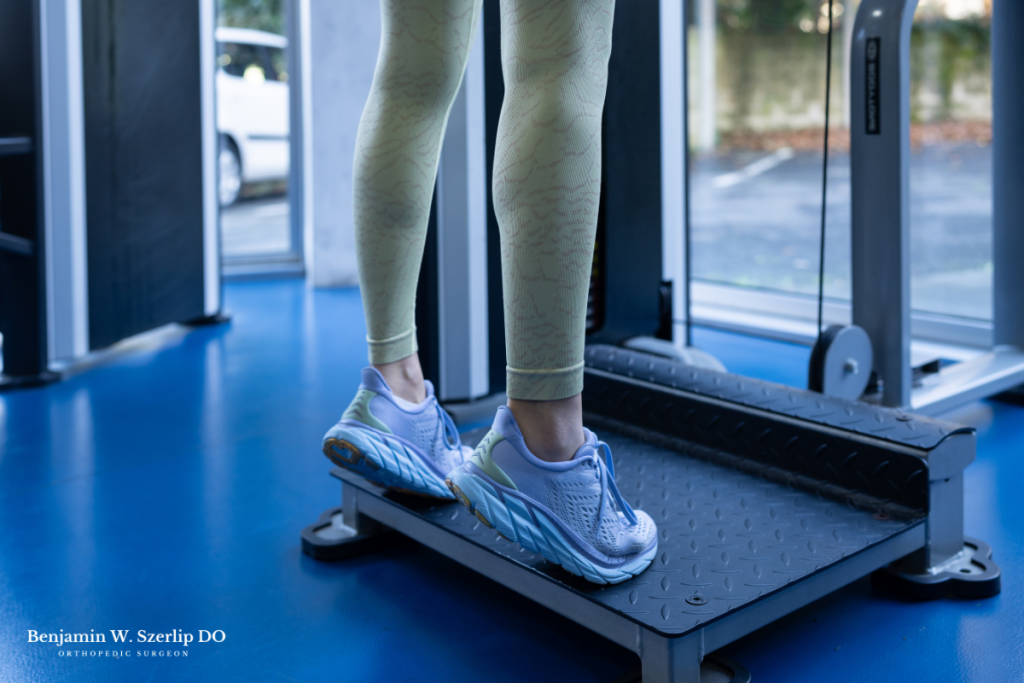
The rehabilitation process for an Achilles tendon rupture follows these specific phases:
The goal of this phase is to protect the Achilles tendon following surgery. You will wear a splint or protective boot with your foot held in plantar flexion. You will be required to keep the weight of your injured foot and will need to use crutches to move around.
During this phase, you will need to control the swelling and pain. Your doctor may recommend cryotherapy to help reduce swelling. Your doctor will give you medication for the pain. Keeping your leg elevated can also help with the swelling.
During physiotherapy sessions, you will need to avoid any active ankle motion. However, you will want to maintain the mobility in your knee and hip. You will be given exercises that encourage core and glute activation.
Now that your tendon has had some time to heal, you can begin some ankle movements through safe planes of motion. This can help prevent stiffness in your ankle.
During movements, your foot should not go into dorsiflexion beyond neutral. This is the movement where your toes are flexed toward your shin. The neutral position is when your foot is at right angles to your leg. There should also be no resistance as you put your foot in plantar flexion (toes pointing downward).
During this phase, you should continue with the other hip, knee, and core exercises.
During this phase, you will gradually return to full weight-bearing on your injured foot. You will continue to wear the boot until around week 8, subject to clearance from your surgeon. They will assess the tendon healing.
You will continue to increase the range of motion in your ankle within safe limits. Using a light resistance band, you will be able to perform movements including plantar flexion, inversion (rotating the outside of the ankle downwards), and eversion (rotating the inside of the ankle downwards). Seated heel raises may also be possible.
Your physical therapist will begin gait training with you. This may include balance and proprioceptive drills to help you return to your normal walking patterns.
During this phase of recovery, you can use a stationary bike while wearing the boot.
During this phase, you will begin to focus on restoring strength, balance, and endurance. By this time, you will normally be wearing shoes, perhaps with a heel lift.
You will progress to the following closed-chain strengthening exercises
You can work on your fitness by using low-impact exercises such as the elliptical trainer or walking in the pool.
By this stage, your ankle should be returning to full strength. You will be able to return to normal activities.
The exercises will now switch to more advanced resistance training as you get back to full strength. Exercise may include light jogging and using an agility ladder. Strength training may include single-leg heel raises. You can also begin some sport-specific training to work back towards pre-injury levels. However, drills involving cutting or pivoting can only be done once your doctor has cleared you.
This final phase will help you return to sport with clearance from your doctor. You will be able to include plyometric and sprint training in your exercise routine. Movements such as cutting and pivoting will be allowed as your Achilles tendon returns to its full strength.
If you’re looking for an expert orthopedic ankle surgeon in Austin or Georgetown, contact Dr. Benjamin Szerlip today. We can help you through the whole process of treatment and recovery.
Rehabilitation focuses on protecting the repaired tendon while gradually restoring mobility, strength, balance, and endurance. The process begins with immobilization and progresses through structured physical therapy exercises and weight-bearing activities.
Recovery occurs in six phases and can take 6–9 months or longer, depending on the patient’s healing and activity goals. Each person progresses at their own pace under the guidance of their surgeon and physical therapist.
Progressive weight-bearing usually begins around 6–10 weeks after surgery. Patients gradually transition toward full weight-bearing while continuing to wear a protective boot until cleared by their surgeon.
Exercises progress throughout rehabilitation and may include range-of-motion exercises, resistance band exercises, seated heel raises, squats, balance drills, leg presses, pool walking, jogging, agility training, and sport-specific exercises.
Return to sports activities typically occurs during the final phase of rehabilitation, around 6–9 months or later. High-impact activities such as sprinting, cutting, and pivoting are only introduced after the tendon has regained sufficient strength and your doctor provides clearance.
Dr. Szerlip has joined forces with Austin Orthopedic Institute
Located at: 11675 Jollyville Road Suite 207, Austin, TX 78759
and 1410 Blue Ridge Dr. Ste 100, Georgetown, TX 78626
Call 512-856-1000 to request an appointment.