
Dr. Szerlip has joined forces with Austin Orthopedic Institute
Located at: 11675 Jollyville Road Suite 207, Austin, TX 78759
and 1410 Blue Ridge Dr. Ste 100, Georgetown, TX 78626
Call 512-856-1000 to request an appointment.
Rehabilitation following patellar tendon repair surgery is essential to returning safely to sports. Your doctor and physical therapist will work closely with you to progressively increase mobility and strength in your knee joint so that you can get back to the activities you enjoy.
At Benjamin W. Szerlip, DO, in Austin and Georgetown, Texas, we specialize in knee and sports medicine. Schedule a consultation with our fellowship-trained shoulder and sports medicine surgeon today!
“Great staff at reception area. Very pleasant and professional medical staff. Wait time was appropriate. I appreciate Dr. Szerlip’s approach. He answered all my concerns. I’ll continue to receive steroid injections as long as they’re helpful. Then will work to create a plan to maintain my shoulder function. So, no complaints.” — Gretchen H.
The patella tendon attaches the patella (knee cap) to the tibia (shin bone). The quadriceps tendon attaches to the patella. These connections allow the quadriceps muscles to pull the lower leg into extension (straight). A partially torn tendon can make it uncomfortable to bear weight on your injured leg. A complete tear can be disabling.
If you experience a large patellar tendon tear, you will likely need surgery to repair it. Following surgery, physical therapy is essential to restore strength and mobility.
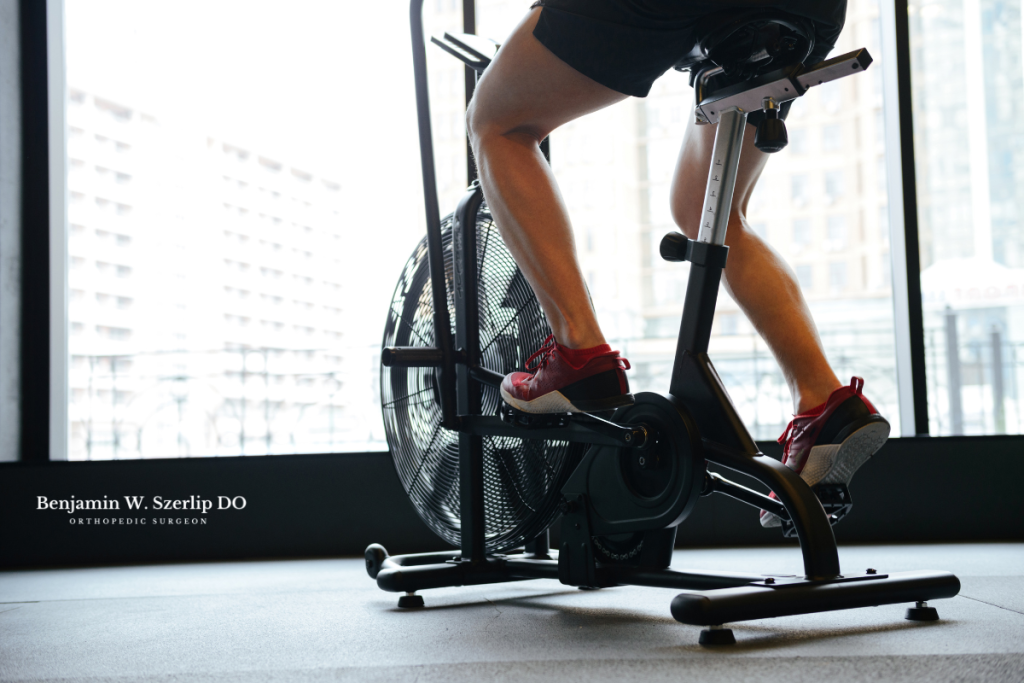
Following the surgical repair for a torn patellar tendon, you will need to follow a structured protocol to return safely to activities and sports.
The goals through this phase are to protect the surgical site, control pain and swelling, and maintain mobility in your hip and ankles.
To protect the patella repair, your leg will be braced in extension. Weight-bearing is possible on your injured knee as long as you can tolerate it. Your physical therapist may move your knee with passive range of motion exercises within the prescribed limits.
Cryotherapy can help reduce swelling during the first few weeks. You may also be encouraged to keep your affected leg elevated and in a compression stocking while you’re at home. These measures can also reduce swelling and discomfort.
You will be given exercises to prevent your hip and ankle from getting stiff. You will need to keep the knee brace on to prevent any active patella movement through leg extension. Quadricep activation with the help of neuromuscular electrical stimulation (NMES) can help reduce muscle wasting.
The goal during this phase is to achieve active-assisted range of motion (AAROM). You can start to use a stationary bike as a controlled mobility exercise. As you restore your mobility and strength, the knee brace will gradually be unlocked.
Strengthening exercises will focus on progressive quadricep activation and closed-chain strengthening such as straight leg raises with brace locked in extension and mini squats.
Gait training will be given as you progressively begin weight bearing on your affected leg.
Much of the focus on this phase is restoring knee function and strength. You may use resistance bands and bodyweight exercises such as mini squats and step-ups. Good form is essential, making sure that your knees are properly aligned during exercises.
Functional training will include proprioception and balance training. This may include single-leg stability drills. You will need to avoid any unstable exercises that are beyond your ability to maintain control.
Progressive mobility exercise will help restore the full range of motion in your knee during this phase. You will continue to exercise on the stationary bike, progressing to the elliptical trainer.
By this stage, you will be progressing your strength and function through more advanced exercises. These may include lunges and single-leg strengthening exercises for additional balance training, and leg presses for increased load on the quadriceps. You will need to monitor the pain and irritation on the patella tendon, making sure that you do not progress too quickly.
Functional training may now include light plyometric exercises and other advanced proprioception drills. Focus will again be on good form during movements and landing after any jumping exercises. You will not be able to do any exercises that involve cutting or pivoting at this stage.
During this phase, you will also rebuild muscle endurance and functional conditioning. This will help you return to recreational activities.
The final phase of recovery will help you safely return to sports. The exercise you will do in this phase of recovery will mimic the movements you do in sports. Your doctor and rehabilitation team will need to clear you before performing some of these exercises. Exercises may include the following:
When you are ready for sports, your rehabilitation team will clear you.
If you’re looking for an expert orthopedic knee surgeon in Austin or Georgetown, contact Dr. Benjamin Szerlip today. We will support you from the surgical procedure, through rehabilitation, until you reach your sports or activity goals.
The patellar tendon connects the kneecap (patella) to the shin bone (tibia). Together with the quadriceps tendon and muscles, it helps straighten the knee and allows movements such as walking, running, jumping, and standing.
Physical therapy is essential after surgery to restore knee mobility, rebuild quadriceps strength, improve balance, and safely return patients to normal activities and sports. Rehabilitation also helps protect the repaired tendon during healing.
During the first phase of recovery, the knee is protected in a brace locked in extension while swelling and pain are managed with cryotherapy, elevation, and compression. Exercises focus on maintaining hip and ankle mobility and activating the quadriceps without stressing the repair.
Strengthening exercises gradually begin during the second and third phases of rehabilitation. Patients progress from controlled quadriceps activation and mini squats to resistance exercises, balance training, and functional strengthening as healing improves.
Return to sports generally occurs after 6 months or longer, depending on healing and functional progress. Advanced rehabilitation includes running, agility training, plyometrics, cutting drills, and sport-specific exercises before clearance is given by the rehabilitation team.
Dr. Szerlip has joined forces with Austin Orthopedic Institute
Located at: 11675 Jollyville Road Suite 207, Austin, TX 78759
and 1410 Blue Ridge Dr. Ste 100, Georgetown, TX 78626
Call 512-856-1000 to request an appointment.