
Dr. Szerlip has joined forces with Austin Orthopedic Institute
Located at: 11675 Jollyville Road Suite 207, Austin, TX 78759
and 1410 Blue Ridge Dr. Ste 100, Georgetown, TX 78626
Call 512-856-1000 to request an appointment.
Tricep tendon repairs performed through surgery have good outcomes for those wanting to return to sports and other activities. Rehabilitation is an essential part of recovery and follows clear stages of progression.
At Benjamin W. Szerlip, DO, in Austin and Georgetown, Texas, we specialize in sports medicine and rehabilitation. Schedule a consultation with our fellowship-trained shoulder and sports medicine surgeon today!
“Great staff at reception area. Very pleasant and professional medical staff. Wait time was appropriate. I appreciate Dr. Szerlip’s approach. He answered all my concerns. I’ll continue to receive steroid injections as long as they’re helpful. Then will work to create a plan to maintain my shoulder function. So, no complaints.” — Gretchen H.
The triceps muscles are found on the back of the arm. Its primary function is to aid pushing movements and arm extension at the elbow. The triceps tendon attaches the triceps muscle to the forearm (ulnar) at the olecranon.
Tears to the triceps tendon may be partial or complete. The course of treatment will depend on the severity of the injury and the amount of strength a patient has while straightening the elbow. You will learn about the available treatments and discuss whether surgery is the best option so that you can make an informed decision.
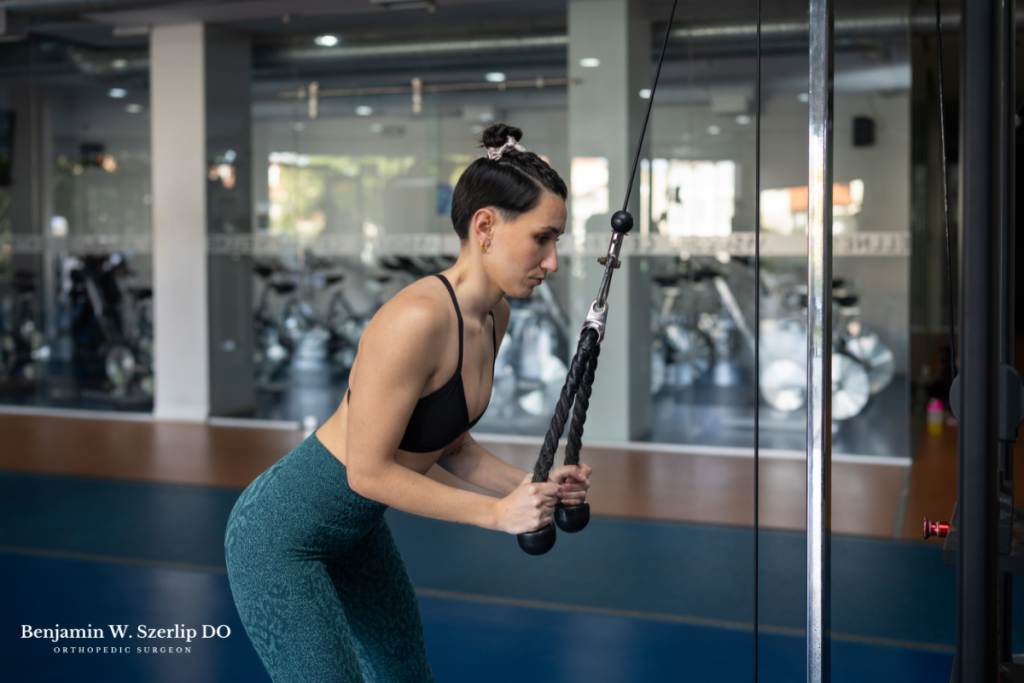
Following triceps tendon repair surgery, you will need to undergo a period of rehabilitation for several months. Gradual progression through physical therapy will ensure long-term benefits to your recovery.
The initial part of recovery is aimed at protecting the surgical repair. Your arm will be placed in a splint or hinged brace fixed between 0 and 30° flexion. You should avoid all types of weight-bearing on your affected arm, including movements like pushing yourself up from a chair and lifting.
You will control the swelling through cryotherapy and other edema-controlling techniques. You will be monitored for symptoms such as excessive swelling, redness, or increased pain.
While movement is restricted at your elbow, you will need to maintain mobility in the surrounding joints. Range of motion exercises will be given to you for your fingers, wrists, and shoulders. Gentle scapular setting exercises will also help maintain scapular strength.
During this phase, your doctor will gradually unlock your elbow brace to allow motion in your elbow. Your physical therapist will begin with passive range of motion (PROM) exercises, progressing to assisted active range of motion (AAROM) exercises. You will also start forearm pronation and supination movements with your elbow flexed.
During all these exercises, you will need to be careful not to overstretch or damage the triceps tendon. Your doctor will want to monitor your pain level and swelling after any exercise.
You will be permitted to perform specific exercises to maintain upper extremity strength during this phase. This may include isometric grip strengthening, wrist strengthening, and shoulder exercises, as long as there is no triceps muscle activation. At this stage, you should not be lifting anything over 1-2 pounds, weight-bearing on your affected arm, pushing, or pulling.
During phase three of your rehabilitation, you will be working back towards the functional range of motion in the elbow through progressive mobility exercises.
At around eight weeks, physical therapy may include isometric contractions in your triceps. This may involve pushing against an immovable object. You will need to be careful not to exert full power in the isometric hold as you activate your triceps muscle. This could overly irritate your tendon.
You will continue to maintain the strength in the surrounding muscles. Resistance training for the shoulder with therabands or resistance machines may be introduced. You will also continue to progress with your wrist and forearm strengthening exercises.
During this phase, your focus will be on increasing the resistance through elbow flexion and extension. Exercises will likely be functional, focusing on pulling and pushing. Progression will be gradual to avoid irritating the triceps tendon.
Around this time, you will return to the full range of motion and strength. You’ll start sport-specific or work-specific drills to condition yourself for participation in these activities. This may include plyometric and power training.
Your doctor will need to clear you before you return to sports. You must continue a conditioning program even after you return to sports to make sure that you maintain strength in the triceps tendon.
At the office of Dr. Benjamin W. Szerlip, in Austin or Georgetown, Texas, our team can support you from the surgical repair through rehabilitation. Contact us today and let us help you return to the activities you love.
The triceps tendon connects the triceps muscle to the ulna at the elbow. It helps with elbow extension and pushing movements used in daily activities, sports, and lifting.
Rehabilitation typically lasts several months and progresses through multiple phases. Most patients begin returning to sports or work-related activities around 4–6 months after surgery, depending on healing and recovery speeds.
Early recovery requires protecting the repair by avoiding weight-bearing, lifting, pushing, and pulling with the affected arm. Patients often wear a splint or hinged brace while the tendon heals.
Light strengthening exercises usually begin around 6–10 weeks after surgery. Early strengthening may include gentle isometric contractions.
Yes. Many patients successfully return to sports and other activities after completing rehabilitation. Sport-specific drills, plyometric exercises, and power training are typically introduced later in recovery once cleared by the doctor.
Dr. Szerlip has joined forces with Austin Orthopedic Institute
Located at: 11675 Jollyville Road Suite 207, Austin, TX 78759
and 1410 Blue Ridge Dr. Ste 100, Georgetown, TX 78626
Call 512-856-1000 to request an appointment.