
Dr. Szerlip has joined forces with Austin Orthopedic Institute
Located at: 11675 Jollyville Road Suite 207, Austin, TX 78759
and 1410 Blue Ridge Dr. Ste 100, Georgetown, TX 78626
Call 512-856-1000 to request an appointment.
Pectoralis major tendon tears usually require surgical management followed by a scheduled rehabilitation plan. This article outlines the protocol for recovery so that you can safely return to sports.
At the office of Benjamin W. Szerlip, DO, in Austin and Georgetown, Texas, we specialize in sports medicine. Schedule a consultation with our fellowship-trained shoulder and sports medicine surgeon today!
“Great staff at reception area. Very pleasant and professional medical staff. Wait time was appropriate. I appreciate Dr. Szerlip’s approach. He answered all my concerns. I’ll continue to receive steroid injections as long as they’re helpful. Then will work to create a plan to maintain my shoulder function. So, no complaints.” — Gretchen H.
The pectoralis major tendon connects the pectoralis major muscle to the arm bone (humerus). They work together to allow movement of the arm toward the center of the body (adduction), rotation of the arm inward (internal rotation), and raising the arm (flexion).
Pectoralis major tendon tears can be partial or complete. Complete tears can occur at the attachments on the clavicle (collarbone), sternum (breastplate), at the humerus (upper arm bone), or within the muscle belly. Pectoralis major injuries commonly occur when the muscle is under eccentric loads, such as the downward movement of a bench press.
Acute injuries are usually repaired through surgical intervention, especially if there was a complete rupture.
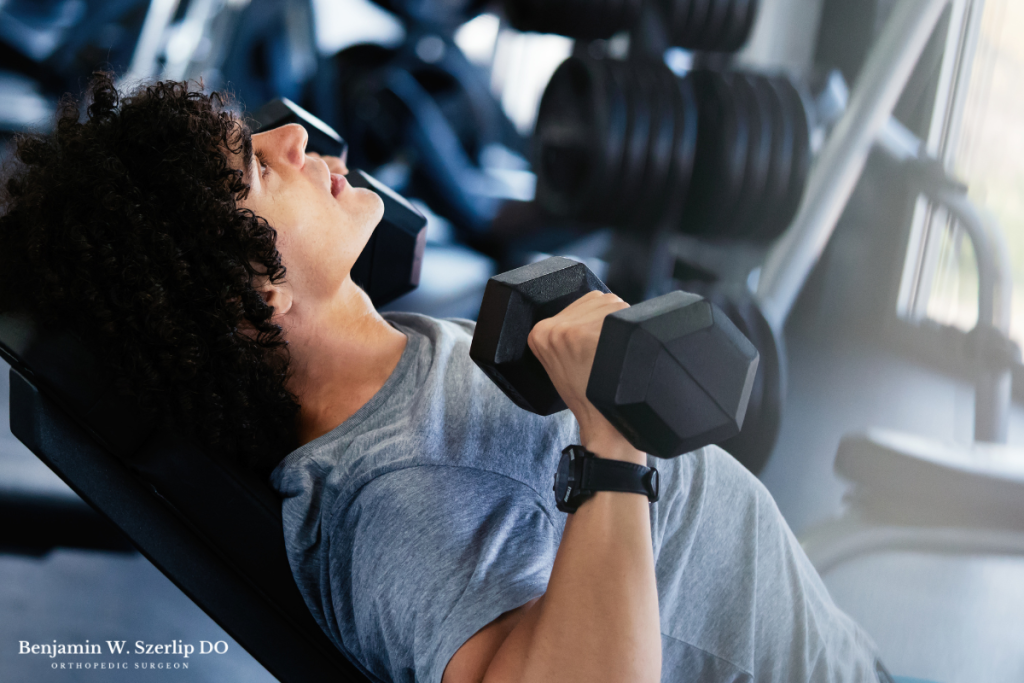
Following a pectoralis major repair, you will follow a schedule of rehabilitation to safely return to sporting activities.
Following surgery, you will need to protect the surgical repair. Your affected arm will be put in a sling with an abduction pillow. The pillow will put your arm at an angle from your torso, allowing the tendon to relax.
During the initial recovery, you will need to control the swelling. The elevated positioning in the sling will help a little. You may also use cryotherapy to help further reduce swelling.
During this initial phase, you will not be able to do any lifting or pushing, and you’ll need to avoid any active shoulder flexion. However, you will need to maintain the mobility in the surrounding joints. Gentle pendulum swings and scapular mobility exercises will help prevent your shoulder from seizing. You will also be encouraged to do range-of-motion exercises for your elbow and wrist.
In order to regain mobility, your physical therapist will help you progress from passive range of motion (PROM) exercises to active-assisted range of motion (AAROM) exercises. At this stage, you are still not permitted to do any resisted movements with your pectoralis muscle.
You can begin some functional use of your arm during this phase. The amount of weight you can carry will progress through the weeks of recovery:
You will continue with the scapular stabilization exercises and incorporate rotator cuff isometrics.
By this phase, you should be able to perform an active range of motion in your chest. You can also begin light chest work with resistance bands. Chest adduction (flys) is still prohibited, but you can perform pushing movements with light resistance.
By four months, you can begin progressive strengthening in your pectoralis muscle. The intensity should progress gradually to avoid injury. You will be permitted to use the following exercise equipment as you build back your strength:
Plyometrics and other explosive movements are not permitted at this time.
The goal of this phase is to return to full strength so that you can return to sports.
You will now be able to participate in plyometric training, agility exercises, open-chain exercises, and sport-specific drills with the aim of getting ready for sports participation.
Before returning to sports, it’s important to get clearance from your doctor.
At the office of Dr. Benjamin W. Szerlip in Austin and Georgetown, Texas, we specialize in sports injuries. Our team can help you from repair through to rehabilitation so that you can be ready to get back in the game. Contact us today.
The pectoralis major tendon connects the chest muscle to the humerus (upper arm bone). It helps move the arm inward, rotate it internally, and raise the arm during pushing and lifting movements.
Pectoralis major tendon injuries commonly happen when the muscle is placed under heavy eccentric load, such as during the downward phase of a bench press.
Rehabilitation generally lasts 6–9 months or longer, depending on healing, strength recovery, and activity goals. Recovery progresses through several structured phases before returning to sports.
During the early stages of recovery, patients must avoid lifting, pushing, resisted chest exercises, and active shoulder flexion. A sling with an abduction pillow is typically used to protect the repair.
Light resistance exercises usually begin around 12–16 weeks after surgery, while more advanced strengthening with resistance bands, machines, and free weights is introduced between 4–6 months of recovery.
Dr. Szerlip has joined forces with Austin Orthopedic Institute
Located at: 11675 Jollyville Road Suite 207, Austin, TX 78759
and 1410 Blue Ridge Dr. Ste 100, Georgetown, TX 78626
Call 512-856-1000 to request an appointment.