
Dr. Szerlip has joined forces with Austin Orthopedic Institute
Located at: 11675 Jollyville Road Suite 207, Austin, TX 78759
and 1410 Blue Ridge Dr. Ste 100, Georgetown, TX 78626
Call 512-856-1000 to request an appointment.
An MPFL injury sometimes occurs after a patella dislocation. Surgical reconstruction is often required to restore stability in the knee. Rehabilitation following surgery will help strengthen the ligament and knee, helping you return to the activities you enjoy.
At Benjamin W. Szerlip, DO, in Austin and Georgetown, Texas, we specialize in knee and sports medicine. Schedule a consultation with our fellowship-trained shoulder and sports medicine surgeon today!
“Great staff at reception area. Very pleasant and professional medical staff. Wait time was appropriate. I appreciate Dr. Szerlip’s approach. He answered all my concerns. I’ll continue to receive steroid injections as long as they’re helpful. Then will work to create a plan to maintain my shoulder function. So, no complaints.” — Gretchen H.
The medial patellofemoral ligament helps stabilize your kneecap, preventing it from sliding sideways. Following a patella dislocation, most patients will tear their MPFL. A torn MPFL normally needs to be reconstructed to restore stability. This is especially true if the patella continues to dislocate.
Following the surgical procedure, you will need to follow a structured rehabilitation program to restore the strength in the ligament and avoid future dislocations.
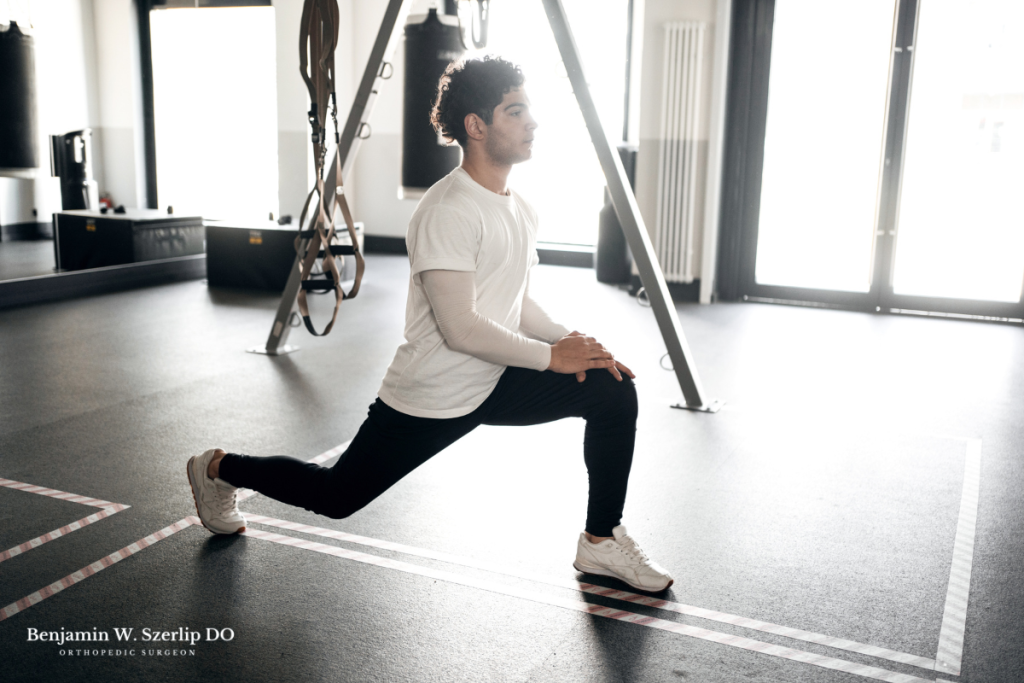
Following MPFL reconstruction surgery, you will need to undergo physical therapy to return to your normal activities, including sports.
Following surgery, you will need to protect the surgical site. Your knee will be brace-locked in extension with a knee brace, and you will walk with crutches. You will also want to avoid any stress on the side of your patella. Weight-bearing is allowed as much as it can be tolerated.
You will also want to control the pain and swelling during this initial phase. Cryotherapy can be done at the rehabilitation clinic to control swelling around the surgical site. Ice packs, compression stockings, and keeping your affected leg elevated are some ways to reduce swelling and discomfort at home. Ankle pumps can also aid in circulation.
Exercises at this time are limited to quadricep activation through straight leg raises. You will also begin gentle heel slides to begin movement in your knee joint.
During this phase, you will aim to restore 90 degrees of motion in your knee by week 4. Your physical therapist will help you progress from passive range of motion (PROM) to active-assisted range of motion. As your range of motion returns, you may be able to use a stationary bike without resistance.
You will continue to improve quadriceps activation by performing straight leg raises in all planes. You will also begin strengthening your hip and core muscles and start gait (walking patterns) training.
You should now be approaching the full range of motion in your knee. This will allow you to add resistance in stationary cycling and perform weight-bearing activities such as mini squats and step-ups. You will need to be careful not to let your knees bend inwards while squatting, as this can strain the MPF ligament.
Other exercises will be given to increase your balance and proprioception. These exercises will prepare you to return to your normal walking gait. Running and plyometrics will still be too much for you during this phase.
At three to four months, you will introduce new exercises to increase your strength and proprioceptive skills. Exercises may include the following:
Most people are not ready for twisting or pivoting movements during this phase of recovery.
The final stage of rehabilitation, you will aim to restore full strength, balance, and endurance so that you can return to your normal activities, including participation in sports.
Your exercise routine will include the following:
If you’re looking for an expert orthopedic knee surgeon in Austin or Georgetown, contact Dr. Benjamin Szerlip today. We will take care of you from the initial treatment through rehabilitation for a smooth recovery.
The medial patellofemoral ligament (MPFL) helps keep the kneecap stable and prevents it from sliding sideways. When the kneecap dislocates, the MPFL is often torn, which can lead to ongoing instability if not properly treated.
MPFL reconstruction surgery is commonly recommended after a patella dislocation when the ligament is torn, and the kneecap continues to feel unstable or repeatedly dislocates. The procedure helps restore knee stability and improve function.
During the first phase of recovery, the knee is protected with a brace while swelling and pain are managed with ice, compression, elevation, and limited exercises. Gentle movements such as heel slides and quadriceps activation exercises are introduced early in rehabilitation.
Recovery after MPFL reconstruction progresses through several rehabilitation phases over approximately 4–6 months or longer. The timeline varies depending on healing, strength, range of motion, and readiness to return to sports or other physical activities.
Return to sports typically occurs during the final stage of rehabilitation once strength, balance, endurance, and knee stability have been restored. Advanced agility drills, cutting movements, pivoting, and sport-specific training are introduced before full clearance is given by your provider.
Dr. Szerlip has joined forces with Austin Orthopedic Institute
Located at: 11675 Jollyville Road Suite 207, Austin, TX 78759
and 1410 Blue Ridge Dr. Ste 100, Georgetown, TX 78626
Call 512-856-1000 to request an appointment.