
Dr. Szerlip has joined forces with Austin Orthopedic Institute
Located at: 11675 Jollyville Road Suite 207, Austin, TX 78759
and 1410 Blue Ridge Dr. Ste 100, Georgetown, TX 78626
Call 512-856-1000 to request an appointment.
Knee pain can make everyday tasks difficult. Understanding the underlying cause can help you get the treatment you need to find relief and get you back to the things you enjoy.
If you are experiencing new, recurring, or ongoing chronic knee pain, then our fellowship-trained shoulder and sports medicine surgeon, Dr. Benjamin W. Szerlip, can help. Schedule your appointment in Austin or Georgetown, Texas, today.
“Great staff at reception area. Very pleasant and professional medical staff. Wait time was appropriate. I appreciate Dr. Szerlip’s approach. He answered all my concerns. I’ll continue to receive steroid injections as long as they’re helpful. Then will work to create a plan to maintain my shoulder function. So, no complaints.” — Gretchen H.
The knee joint is made up of many structures that provide movement and stability. These include the thigh and shin bones, ligaments, tendons, and cartilage. Knee pain can arise from damage to any one of these structures.
Pain can be caused by injury, inflammation, repetitive stress, wear and tear, or mechanical problems. Depending on the structure that is damaged, you may feel the pain in front of your knee, on the inside edge of your knee, the outside edge of your knee, or behind your knee. Minor knee pain may be treated at home. However, persistent or severe knee pain may require an evaluation by a knee specialist.
The common causes of knee pain include injuries, overuse, and arthritis.
Knee injuries are common causes of knee pain. Acute injuries can occur through impact injuries, sudden twisting and directional changes, or falling awkwardly. The ligaments, cartilage, and the meniscus are particularly susceptible to these types of injuries.
Repetitive activities such as jumping or frequent knee bending can lead to knee pain. Repetitive movements can cause inflammation in the bursa or tendons. Muscle imbalances such as weakness in the hip and tightness in the muscles around the knee can also put strain on the knee, causing pain.
Another common cause of knee pain is arthritis. The most common form is osteoarthritis. This is often referred to as wear-and-tear arthritis, as it develops over time, particularly in those over the age of 50. Knee pain can also be caused by rheumatoid arthritis. This is an autoimmune disease that affects both joints at the same time.
Some of the most common knee conditions that cause pain include the following:
While some causes of knee pain may go away with home treatments, other symptoms may warrant an evaluation by a knee doctor. If you have any of the following symptoms, it is recommended that you see an orthopedic knee specialist:
Severe swelling or a visible deformity may require immediate medical attention, especially if you had just experienced a traumatic injury.
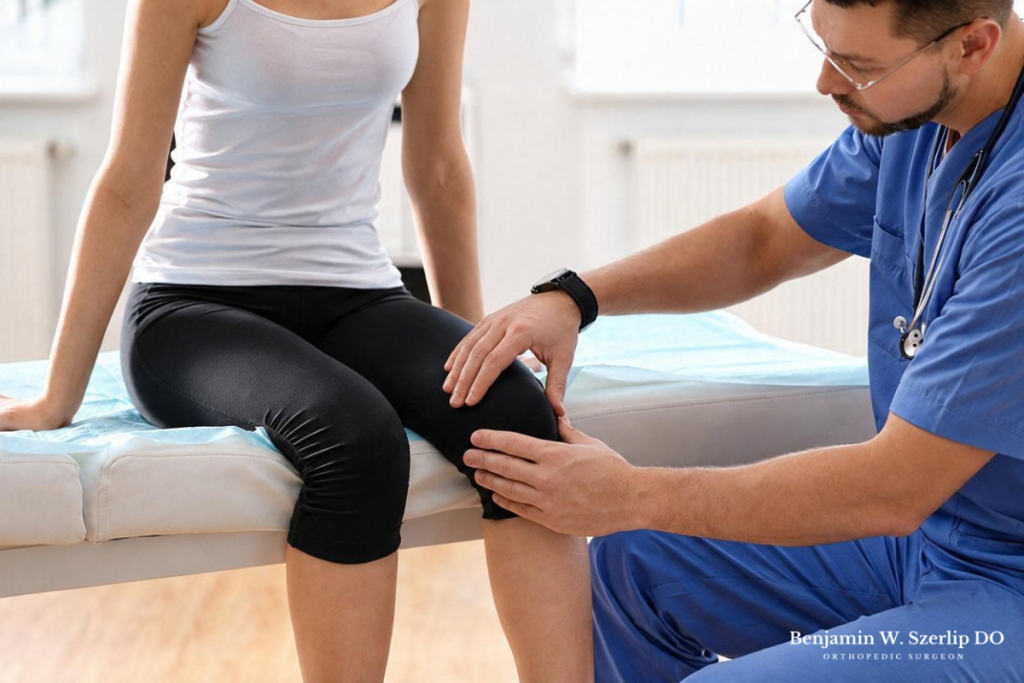
Your knee doctor will begin their diagnosis by asking about your medical history and your symptoms. They will then perform a physical examination to assess for muscle strength, range of motion, swelling, and tenderness.
Your doctor may then order imaging tests according to the suspected injury. X-rays are commonly used to detect fractures of the bone. MRI scans can be used to visualize the soft tissues in the knee for further diagnosis. When the diagnosis is complete, your doctor will develop an individualized treatment plan to treat knee pain and restore function.
In many cases, the causes of knee pain can be treated with non-surgical treatments. Some of the non-surgical treatment options available include the following:
Surgery may be recommended when there is either severe structural damage or when non-surgical treatments are no longer providing relief. The surgical procedures chosen will depend on your condition and your treatment goals.
Some surgical procedures Dr. Szerlip offers to treat knee pain include the following:
Dr. Szerlip is a fellowship-trained shoulder and sports medicine surgeon with more than 15 years of experience helping patients in Austin and Georgetown, Texas. He specializes in sports medicine injuries and general orthopedic care.
Dr. Szerlip evaluates the underlying cause of knee pain before recommending treatment. Each treatment plan is tailored to the patient’s individual needs and goals. When appropriate, he may recommend nonsurgical treatments before considering surgery.
Don’t allow persistent knee pain to limit your daily activities. Dr. Szerlip can evaluate your knee pain and provide tailored relief. Schedule your appointment in Austin or Georgetown, TX.
It’s recommended to see a knee specialist if you have persistent, worsening, or severe pain, significant swelling, instability, or difficulty moving the knee.
Common causes of pain without a sudden injury include arthritis, overuse, or repetitive stress. These can cause tendon problems, bursitis, and other conditions.
Yes. Depending on the underlying cause, treatment such as activity modification, physical therapy, exercise, bracing, and other conservative approaches may provide pain relief.
Surgery may be considered when there is significant structural damage or when persistent symptoms do not improve with appropriate nonsurgical treatment.
Dr. Szerlip has joined forces with Austin Orthopedic Institute
Located at: 11675 Jollyville Road Suite 207, Austin, TX 78759
and 1410 Blue Ridge Dr. Ste 100, Georgetown, TX 78626
Call 512-856-1000 to request an appointment.